Write Way Designs - Ask Susana

Jobs & Careers at
Write Way Designs
Google+















Susana Rosende

Create Your Badge




(Your ad could
be here!)


(Your ad could
be here!)

(Your ad could
be here!)



(Your ad could
be here!)


Ask Susana Advice Column
 Susana Maria Rosende holds a BA in English/Technical Communication from the University
of Central Florida
and has over
20 years experience in
technical writing
and editing.
Here, she candidly
answers your questions and
shares helpful suggestions
for how to be a successful
technical writer.
Susana includes
tips on grammar, standard
desktop publishing and graphic tools,
how to join the field of technical communication,
how to make it as a lone writer, how to survive
corporate politics, how to create a work/life balance,
and where to find the best books and online resources
for newbies and experts alike.
Susana Maria Rosende holds a BA in English/Technical Communication from the University
of Central Florida
and has over
20 years experience in
technical writing
and editing.
Here, she candidly
answers your questions and
shares helpful suggestions
for how to be a successful
technical writer.
Susana includes
tips on grammar, standard
desktop publishing and graphic tools,
how to join the field of technical communication,
how to make it as a lone writer, how to survive
corporate politics, how to create a work/life balance,
and where to find the best books and online resources
for newbies and experts alike.
Susana also answers questions on related topics in the editorial and creative industries. To send Susana your question or comment, please click Contact.
Questions and Answers
- What is Triage Technical Writing?
- How do I fight writer's block?
- How do I find time to write AND where do I find an affordable PC?
- How do I raise bilingual children in the United States?
- I need inspiration for my writing!
- What, exactly is a Technical Writer?
- What major should my son pursue, besides Zoology and Photography, for a career in Wildlife Photography?
- What are the top tips for writing a Resume?
A: Hi, Tom. First of all congratulations on landing such a great gig in this economy. Many contract Tech Writers would prefer to work from home, and those opportunities are few and far between. Triage Technical Writing seems to be a perfect solution for remote writers and on-site writers alike, as there are often situations when the technical writer needs to do the best job possible under the most dire of conditions (no equipment, no access to equipment, no engineer or documentation available that may answer important questions, tight deadlines where all of the above may be available, but there is just no time!).
To better understand the concept of Triage Technical Writing, consider the Triage practice used in hospital emergency rooms or telephone medical advice systems. Triage in the medical profession is the process of determining the priority of treatment based on severity of condition. This practice rations patient treatment efficiently when resources are insufficient for all to be treated immediately. The term comes from the French verb trier, meaning to separate, sift, or select.
Triage originated in World War One by French doctors treating the battlefield wounded at the aid stations behind the front. Until recently, triage results, whether performed by a paramedic or anyone else, were frequently a matter of a best guess as opposed to any real or meaningful assessment. In a battlefield, victims have been divided into three categories using the Primitive Model:- Those who are likely to live, regardless of what care they receive;
- Those who are likely to die, regardless of what care they receive;
- Those for whom immediate care might make a positive difference in the outcome.
Emergency Medical Services (EMS) systems uses a similar model when there are only one or two paramedics for 20 or more patients.
Likewise, Triage Technical Writing is when you take a pragmatic approach to writing and prioritize what information to publish. First and foremost, you must have content that the end user needs to be successful. You must also have content that would keep the end user safe from death or injury. You must have clear language and grammar so that the content is easily understood.
Second, you must have supporting information such as more details about the product, but this information is secondary to that which protects a user from injury or death or from successfuly using the product. In other words, this information is a nice-to-have, but not urgent.
Third, time-permitting, you can go back and fix language for consistency and to meet verbiage standards. You know, the type of content that is included in the Style Guide and Editors get into a tizzy about (and yes, I've been a Technical Editor as well as a Technical Writer), but does not qualify as a Life and Death situation. An example would be to say Press the Pushbutton instead of Press the Button. This type of language cleanup is a technical writing Best Standards practice, even when there is little time to do a thorough edit of the content, but in extreme deadlines (and all of us have been there) it cannot always be completed in the first iteration of a manual.
In other words, in Triage Technical Writing, you must include the information that is urgently needed in your manual, such as the safety warnings to prevent injury or death, and the must-know information that will ensure the product is successfully used by the user. Next, time-permitting, include added details about the product, and finally, ensure standard language is used. But, include the most urgent information first, in case the deadline does not allow the rest.
I hope I've answered your question about the content prioritization method known as Triage Technical Writing! Good Luck!
(Back to Top)How do I fight writer's block?
Q: Hi, I am Joan and have been writing for as long as I can remember. How do I fight writer's block? I always start these writing jolts and stop midway due to writer's block or just loss of interest. For example, I wrote a short story manuscript about victimization. I have a manuscript of poetry and I have a 200-paged manuscript that I am working on but stopped because I feel like something is missing. Any assistance in this area will be greatly appreciated.
A: Hi, Joan, it's a pleasure to hear from a prolific writer such as yourself. I wonder if you feel you need feedback or encouragement for your writing? Maybe you should consider joining a writer's group, even an online one, where you can get encouragement and critiques for your work.
Sometimes, we writers get isolated and then start feeling insecure about ourselves and our work. And sometimes all we need is a little encouragement to feel the motivation we need to get back to doing what we do best -- writing!
Give a writer's group a try, and let me know if that works for you!
Good luck! Please keep in touch! -- Susana (Back to Top)
How do I find time to write AND where do I find an affordable PC?
Q: Hello, Susana! My name is Buffy and I write children's books. I don't have a computer presently, and between juggling writing with my kids and the library always being so busy, it's hard to find a time and place to write!
A: Hi, Buffy. Having raised my children as a single mom for 17 years, I know too well the difficulties of balancing family, work, and writing. I also know the challenges of making ends meet while finding extra funds for the kids' team sports and activities and that much-needed computer!
If money is tight, and who isn't financially-challenged in this economy, consider buying a used or refurbished laptop on eBay or Craigslist.
Years ago, I purchased a used Dell Latitude laptop for $200 from eBay that lasted three years (which is how long computers generally last before you need an upgrade, anyway), so I considered that to be a very good deal. It also came with Microsoft Office, which includes, in part, Word (word processor), Outlook (email), and Excel (spreadsheet application).
While laptops these days don't come loaded with software, consider using open source software, such as Open Office, for free! Go to OpenOffice.org to download the software. Open Office Writer is compatible with Microsoft Word! But the best part is that it's free. Open Office also has suites for Windows, Mac, and Linux users!
If you prefer a new PC, consider shopping at NewEgg.com. You can often get a better deal through an online re-seller than you can at your local Best Buy or Radioshack.
Having a computer at home allows for more time to write! When the kids were young, I often wrote while they were visiting dad or asleep in their beds.Good luck with your writing and with getting a computer! Remember your goals, and never give up! -- Susana (Back to Top)
How do I raise bilingual children in the United States?
Q: Hola Susana. My name is Alejandro and I was wondering if you have any advice for how to raise bilingual children in the United States. I am Cuban-American and my wife is from Colombia. We are bilingual and speak Spanish at home, but our kids are speaking English at home now too and we are afraid they will forget Spanish all together.
A: Hola Alejandro. I think it is admirable that you and your wife want your children to grow up bilingual. The very best way to raise bilingual children is to ensure consistent immersion in both languages. Continue to speak Spanish to your children at home and to insist they speak Spanish to you and your wife, especially if they speak English at school and in the community, and even to each other, as is often the case as they grow older and Spanish is relegated to the status of second language. Also, when they reach junior high, middle school, or high school, and can take a foreign language, insist they take Spanish so they can also learn the grammar rules to read, write, and translate. It will serve them well in the future as it will open up more career possibilities.
For more tips on how to raise bilingual children, please see my article with accompanying links at eHow.com (Back to Top)
I need Inspiration for my writing!
Q: Hi Susana, it's Joan again. I joined the writer's group on Ziggs.com and
MySpace.com. But I need something more.
Like an Internet cafe environment or a poetry reading setting where I can sit with my laptop and get inspired.
A: Hi there, Joan! There's really no replacement for human contact, is there? While Yahoo Writer's Groups, Writing.com, and the online groups you mentioned can be inspiring and useful, sometimes we have a need to read our work aloud and see and feel the reaction to our words. Consider joining writers groups at your local library or bookstore, or joining or even starting a Meetup Group for Creative Writers in your area. You can search and sign up at Meetup.com Also, consider taking a creative writing class at your local community college or university. And as you suggested yourself, sit in a coffee shop or in a park or beach with your laptop to find inspiration.
Also, somtimes taking a break and getting out to both live and observe LIFE is helpful! Get away from your computer and out there, as my brother likes to tell me, in the 3-dimensional world! Life often imitates, or inspires, Art!
Good luck. -- Susana (Back to Top)
Q: Hello, Susana. What, exactly, is a Technical Writer?
My name is Cory and I've just been accepted to the University of Central Florida here in Orlando. I want to be a novelist, and have had short stories published while I was in high school, so I know I have both talent and motivation. The problem is my parents don't think majoring in Creative Writing is practical and want me to instead major in Journalism, Communications, or Technical Writing to ensure I have a job with a steady income after graduation.
A: Hello, Cory! First of all, congratulations on being published while in high school, on your high school graduation, and on your acceptance to UCF! At a young age, you have accomplished a lot, and if you keep setting and pursuing your goals, you will continue to succeed!
However, it doesn't hurt to be prepared as much as possible for anything that comes your way, and life is full of surprises. So, majoring in Creative Writing and pursuing a minor in Communications, Business, Science, Computer Programming, Engineering, or Health will give you more ammunition for employment in an economy where layoffs are all too common, and publishing houses increasingly take on authors who fulfill the current needs of an often fickle public.
So, what is Technical Communication and what do Technical Writers do? Technical Writers create product instructions, reference and maintenance manuals, articles, project proposals, training materials, technical reports, catalogs, brochures, online documentation and help systems, Web pages, multimedia presentations, parts lists, assembly instructions, and sales promotion materials. We compose communication from product developers for users of the products.
Users include consumers as well as scientists, engineers, plant executives, line workers, and production managers. And we must write in a concise and easy-to-read manner for consumer publications or in highly specialized language for experts. With the increased use of desktop and online publishing, Technical Writers are increasingly responsible for the publication process including graphics, layout, and document and website design. (Back to Top)
To complete our documentation, Technical Writers perform the following tasks:
- Analyze the needs of the target audience.
- Study data and conduct in-depth interviews with subject matter experts to understand the product or procedure.
- Index and cross-reference documents such as bulletins and manuals.
- Produce or arrange for illustrations, charts, and photographs to be included in publications.
- Edit, standardize, or revise material prepared by other writers or personnel.
- Prepare layout of material for publication.
- Prepare rough drafts of the publication for review with the project staff and/or customers.
- Create and edit Web pages for the Internet, intranets, and extranets.
Additionally, Technical Writers often specialize in a specific industry such as agriculture, health care, pharmaceuticals, telecommunications, computers, or manufacturing. Within their chosen industry, many Technical Writers will specialize further. For example, Technical Writers in the IT industry might specialize in software documentation, tutorials, or user manuals. In fact, Technical Writers can look forward to the life-long pursuit of learning needed to keep up with current standards and technologies.
Because Technical Writers present specialized information within strict accuracy and format requirements, this writing requires the ability to concentrate for long periods of time and strong organizational skills. To be successful at our jobs, we must use the following skills, knowledge, and abilities to accomplish our daily tasks:
- Writing - Communicating effectively with others in writing as indicated by the needs of the audience.
- Active Listening - Listening to what other people are saying and asking questions as appropriate.
- Speaking - Talking to others to effectively convey information.
- Information Gathering - Knowing how to find information and identifying essential information.
- Information Organization - Finding ways to structure or classify multiple pieces of information.
- Synthesis/Reorganization - Reorganizing information to get a better approach to problems or tasks.
- Active Learning - Working with new material or information to grasp its implications.
- Product Inspection - Inspecting and evaluating the quality of products.
- English Language - Knowledge of the structure and content of the English language including the meaning and spelling of words, rules of composition, and grammar.
Some firms will only hire experienced Writers who specialize in one field of technology. Many employers prefer applicants with a four-year college degree in English, Communications, Engineering, Journalism, or with a degree or certificate in technical writing. Some employers require a strong background of technical knowledge and experience, combined with writing skills. Applicants must have good computer skills and may need a working knowledge of specific industry operations and procedures.
Employers also select trainees from among technicians who have backgrounds in science, military equipment, and communications. Applicants should have good communication skills and be able to convey scientific and technical information accurately and clearly.
Computer literacy is a requirement. These days, companies require Technical Writers to be knowledgeable about computer graphics and desktop publishing, including multimedia production. Some Technical Writers may also be required to know and read program languages.
If you consider pursuing a career in technical communication, ensure to take courses in communication, journalism (especially interviewing skills), English, mathematics, physics, chemistry, mechanical drawing, graphic arts, and computer-related subjects. Technical Writers should also acquire a solid background in the industry that interests them as a specialty.
Junior Technical Writers often assist the mid-level and Senior Technical Writers by conducting library research, preparing rough drafts of reports, or performing basic editing tasks. In defense-related organizations, U.S. citizenship is usually required because of the classified nature of some projects.
The outlook for Technical Writing jobs is excellent. In fact, it is estimated that the Technical Writer occupation will grow faster than average compared with all occupations. Cory, you may also find it interesting to note that many successful novelists and authors attributed their former careers in Technical Communication to giving them a good foundation in research and writing. Some of these writers include Amy Tan, Kurt Vonnegut, Thomas Pynchon, Laura Lemay, Dr. JoAnn Hackos, Lisa Higgins, and Jodi Picoult, to name a few. (Back to Top)
For more information about credits needed for a major or minor in Technical Communication at UCF, contact Dr. Dan Jones, Dean of the Technical Communication program in the English Department:
Dr. Dan Jones, Professor
djones@ucf.edu
407-823-5160
CNH-303B
Tuesdays/Thursdays Noon-1:30 p.m. (Back to Top)
For more information about careers in technical communication, join the Future Technical Communicator organization of the Society for Technical Communication (STC), Orlando Chapter, and the online Content Wrangler Community. You may also write to the following organizations:
Society for Technical Communication, Inc.
901 N. Stuart Street, Suite 904
Arlington, VA 22203-1822
(703) 522-4114
Fax: (703) 522-2075
www.stc.org
National Writers Union - National Office West
337 17th Street, #101
Oakland, CA 94612
(510) 839-0110
Fax: (510) 839-6097
www.nwu.org
American Society of Indexers
10200 West 44th Avenue, Suite 304
Wheat Ridge, CO 80033
(303) 463-2887
Fax: (303) 422-8894
www.asindexing.org
American Medical Writers Association
Northern California Chapter
www.amwancal.org
Pacific Southwest Chapter
www.amwa-pacsw.org
Council of Science Editors
c/o Drohan Management Group
11250 Roger Bacon Drive, Suite 8
Reston, VA 20190-5202
(703) 437-4377
Fax: (703) 435-4390
www.councilscienceeditors.org
Editorial Freelancers Association
71 West 23rd Street, Suite 1910
New York, NY 10010
(212) 929-5400
Fax: (212) 929-5439
www.the-efa.org
International Webmasters Association
119 E Union Street, Suite # F
Pasadena, CA 91103
(626) 449-3709
Fax: (626) 449-8308
www.iwanet.org
International Association of Business Communicators
One Hallidie Plaza, Suite 600
San Francisco, CA 94102-2818
(800) 776-4222
Fax: (415) 544-4747
www.iabc.com
National Association of Science Writers
P.O. Box 294
Greenlawn, NY 11740
(631) 757-5664
Fax: (631) 757-0069
www.nasw.org
Good luck to you! -- Susana (Back to Top)
6. What major should my son pursue, besides Zoology and Photography, for a career in Wildlife Photography?
Q: My 20 year old son wants to be a Wildlife Biologist/Photographer. He is currently taking Zoology. Keep in mind that funds are limited. He has a very high IQ (157), but gets bored easily so his grades don't really reflect that. Being a single mom, I am limited to how I can help him financially, other than allowing him to live at home while attending school. He does get some government money, but was trying not to be in too much debt when he graduates.
He has an idea as to what he wants to do and is in his Sophmore year at Kent State. What types of jobs are available for this type of work? What should his course of study be? Are there internship programs available for this sort of thing? His knowledge of animals and their habitats, etc. is pretty vast. He is minoring in Photography. Zoology seemed to be the only major that studied the animals themselves. He does not want to be a Vet, but rather do research and documentaries on endangered and protected species. Thanks in advance for any help you can provide. -- Becca
A: Hi, Becca, your son seems to have definite goals and interests which is wonderful in someone so young. Many college students have no clue what career they wish to pursue upon graduation. I suggest he speak to the dean in the Communications department and perhaps also the Journalism department about his desires to see if a career in Photojournalism would be better served with a major, minor, or Double Major in Communications and Photography, or a major in Photography with a minor in Zoology or Journalism. The university would be better able to provide the answers he needs as they also should have a career center or guidance counselors who can advise him how to better reach his goals.
Good luck to your son! He sounds like he already has his goals. Now, he needs to find the correct path to reach them! --Susana (Back to Top)
7. What are the top tips for writing a resume?
Q: Help! My resume isn't getting any bites? What are some tips to follow?
A: At the International Association of Business Communicators (IABC) site, expert Marie Raperto recommends the following:
- Keep it simple. Do not overuse bold or italic lettering. When sending via e-mail, remember everyone may not have the same equipment/programs that you do.
- Make sure your format is consistent and that your grammar is perfect. No typos!
- Use bullet points instead of lengthy paragraphs.
- If you have less than five years work experience, limit your resume to one page.
- Unless you have many years experience, do not use an objective/summary.
- If you are applying for your first job, put your education first. Otherwise, experience precedes education.
- List the school, the type of degree, the year you graduated and your major/minor. Do not list your courses or GPA. If you have not graduated, list the anticipated graduation date.
- Most recent employment goes first. List the name of the company, a short description of the company, the city and state, the position/title held, and the dates (month and year).
- State your responsibilities in a thorough and concise manner.
- If you worked at a PR agency, highlight the clients/products you worked on.
- List promotion and dates for each position.
- Include professional organization/association memberships and any positions you held. List your professional accomplishments - awards, certifications, honors etc.
- List the experience you have with various software programs, online services.
- Have your references available, if asked for them. Do not include them on the resume.
Finally, do not include any personal information such as a photo, age, weight, height, do not forward your resume to more than one person at the same firm or send different formats simultaneously unless advised to do so, do not hand-write your resume or use colored paper when faxing, and most of all, do not lie. False information such as inflated titles or falsified education can be grounds for dismissal.
For Resume Writing Services, contact Write Way Designs today at 407-670-9554 or susana@writewaydesigns.com. We are now offering RECESSION RATES of 50% OFF, along with our GUARANTEE: No interviews in 30 days, and we rewrite for FREE! For more information, see our Resume Writing Services. (Back to Top)
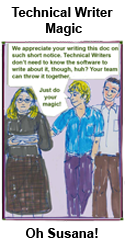
Enjoy Susana's cartoons about Corporate America:

Copyright 1997-2019
281,414 Visitors
www.writewaydesigns.com | susana@writewaydesigns.com | 1-407-670-9554
Susana Rosende, President of Write Way Designs, Executive Director of Communications, Senior Staff Technical Writer, Technical Editor, Marketing Copywriter, Content Strategist, Creative Author, Translator (English/Spanish), Illustrator, Photographer, Painter, Cartoonist, Designer.
susana@writewaydesigns.com and Susana.Rosende@gmail.com | 1-407-670-9554